

Summary: Modern verification systems force individuals to rely on institutions to prove facts about themselves, creating a “proof gap” that becomes untenable in a world of cryptography, AI agents, and machine-speed economic activity. While portable digital credentials can close much of this gap, they depend on a deeper foundation: a publicly governed, legally recognized digital identity that gives people standing, continuity, and enforceable rights across sectors. State-Endorsed Digital Identity (SEDI) provides that non-optional base layer, enabling portable proof, accountable delegation, and interoperable trust infrastructure to function at societal scale.
Sankarshan’s recent essay on the “proof gap” makes an important point: our verification systems were built for a world where institutions speak and people wait. Facts about us—our education, employment, licenses, benefits, and status—are held by institutions. When proof is needed, we usually cannot present it directly in a form that machines can independently verify. We have to ask each institution, one at a time, to confirm what is already known to be true.
That model made sense when verification depended on human intermediaries. It makes far less sense in a world of cryptography, digital credentials, and autonomous agents acting at machine speed. Portable, machine-verifiable credentials offer a way forward. But the essay also points, perhaps unintentionally, to something deeper: if we want this infrastructure to work at scale, we need more than better credentials. We need a legal foundation for first-person digital trust.
That is where State-Endorsed Digital Identity, or SEDI, becomes non-optional.
The layers of proof infrastructure
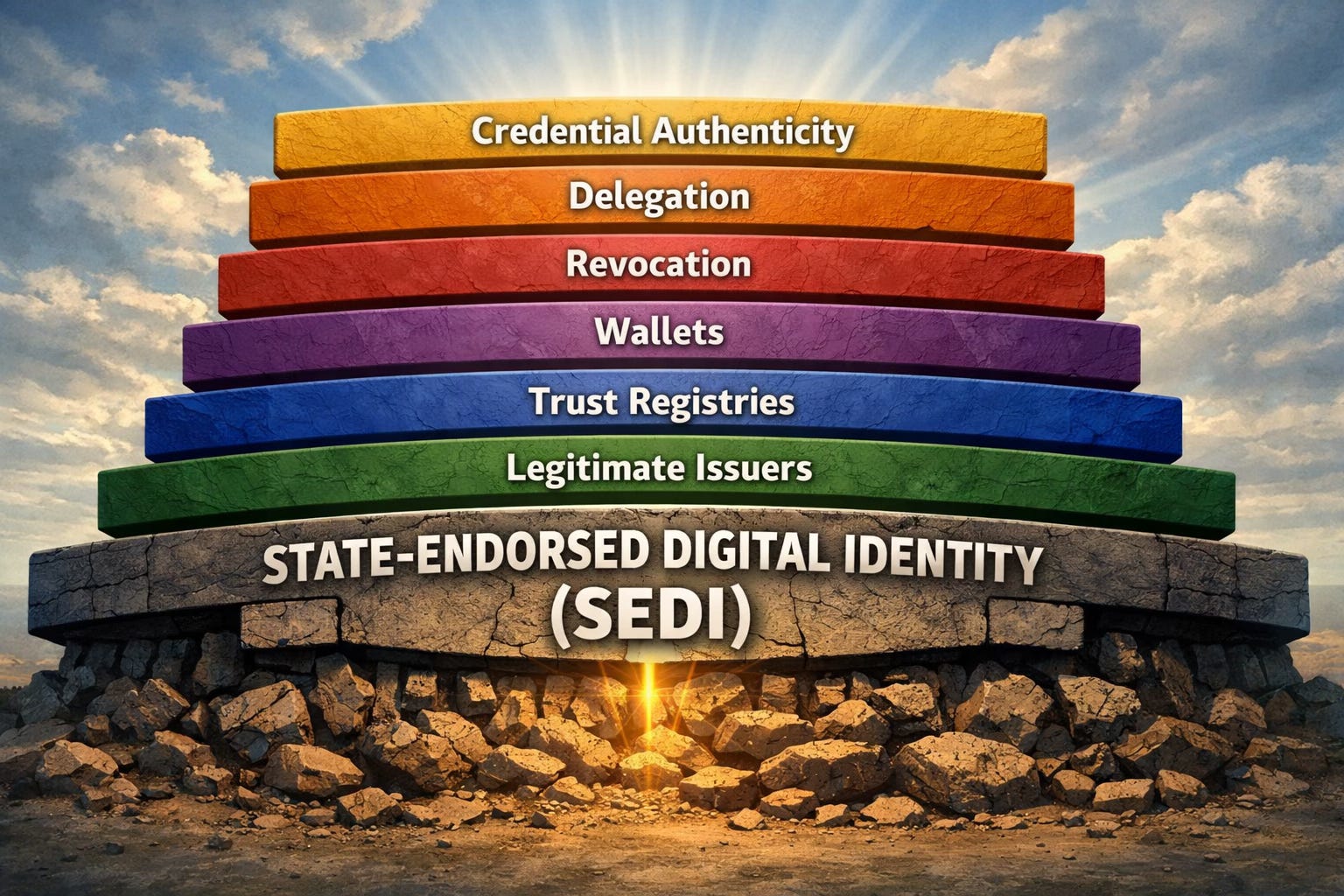
The essay describes a stack of capabilities required to close the proof gap: credential authenticity, legitimate issuers, trust registries, wallets, revocation, delegation, governance, and accountability. Each layer matters. None is sufficient by itself.
But there is a foundational layer beneath all of them: the legally recognized digital identity of the person who holds and presents the proof. Credentials do not exist in the abstract. They are issued to someone. Delegation chains eventually terminate in a principal. Liability and recourse depend on identifying who has standing to dispute an error, challenge a revocation, or authorize an agent to act.
Those are not merely technical questions. They are legal and institutional ones.
The proof gap is also a governance gap
The proof gap is sometimes framed as a failure to adopt modern cryptography. That is true as far as it goes. But the larger failure is one of governance. Private-sector trust frameworks can define accreditation rules, operating standards, and interoperability patterns. They can help institutions trust one another. They can even support impressive technical ecosystems.
What they cannot do on their own is create the public foundations that real digital infrastructure requires: legally recognized assurance levels, enforceable rights to receive credentials, due process around suspension or revocation, standing in administrative and judicial processes, and public accountability when identity systems fail. Those are functions of law and public governance, not just market coordination.
Why SEDI Matters
SEDI is often described as a credentialing initiative, but its real significance is architectural. It provides a publicly governed foundation for first-person digital trust. It gives people a durable, state-endorsed digital identity that can receive, hold, and present credentials across domains.
This does not replace institutional authority. Universities still issue degrees. Licensing boards still grant licenses. Employers still attest employment. Hospitals still issue records and treatment information. But SEDI gives those credentials a legally meaningful home in the hands of the person they describe.
That matters because infrastructure built only on private trust frameworks remains incomplete. It can create islands of interoperability. It cannot, by itself, create broad legal recognition.
SEDI provides what private trust frameworks cannot
First, SEDI establishes a recognized digital principal. In any credential ecosystem, someone has to be the holder of proof. That holder must be identifiable in a way that relying parties can understand and that public institutions can honor. SEDI provides that basis.
Second, SEDI provides legal standing and recourse. One of the essay’s strongest observations is that when institutional systems make errors, individuals are forced to navigate the, often manual, correction process one institution at a time. A public identity foundation can give people enforceable rights to obtain credentials, require institutions to correct errors, provide real avenues for appeal, and make accountability clear when official data is wrong. Private trust frameworks can govern these things in their sphere of influece, but public frameworks can require them universally.
Third, SEDI provides continuity across sectors. Education, healthcare, financial services, licensing, and benefits will each have their own trust frameworks and governing authorities. SEDI does not flatten those differences. It gives them a common way to relate to the person at the center of the transaction.
Fourth, SEDI strengthens accountability in an agentic economy. If software agents are going to act on behalf of people and organizations, delegation must begin with a principal who is legally and institutionally legible. A state-endorsed identity layer makes that possible. Without it, delegation risks becoming a private contractual patchwork, platform-specific, opaque, and difficult to audit when things go wrong.
Infrastructure Is Not Just Technical
It is tempting to focus on credential formats, wallet protocols, or trust registry design. Those are important. But they are not the hardest part and are, in fact, mostly solved problems. The harder question is who governs the system, who has authority to issue and revoke, what rights people have, and what happens when the system fails.
That is why SEDI matters so much. It does not compete with credential ecosystems. It underwrites them. It provides the legal and governance substrate that allows portable proof to become real infrastructure rather than a collection of disconnected technical projects.
Fix proof before agents scale
The essay is right to emphasize urgency. AI agents increase the volume and speed of verification beyond anything human-mediated systems can handle. At the same time, generative AI makes unsigned digital artifacts easier to forge and harder to trust. These pressures make the proof gap impossible to ignore.
But closing that gap will require more than cryptographic credentials. It will require a foundation that lets people hold proof, present proof, delegate authority, and challenge errors as recognized participants in digital society.
That is why SEDI is not optional. If we want portable proof to work across markets, institutions, and agentic systems, then a publicly governed legal identity foundation is not an added feature. It is the base layer.
Fix proof before agents scale. And base it on foundations strong enough to carry the weight of law, accountability, and trust.
Photo Credit: SEDI is the foundation for infrastructure that closes the proof gap from ChatGPT (public domain)
How does SEDI connect to a contextual reputation? Ideally, the contextual reputation is associated with a digital identity exclusive to the context as well as sybil-resistant. Different contexts have different, non-correlatable digital identities for the same legally-accountable human.
I can imagine a structure where a notary-public is enabled to create a link between an accountable SEDI and a contextual (digital identity). The notary would have to check for uniqueness before issuing a different contextual identity to the same legally accountable human. Notary-publics are a manageable governance issue.
Is this a potential solution to contextual reputation or am I missing something.