

Summary: A reader asked for a map of the whole Manifold environment and the functional capabilities of each part. I have described this system across three posts, a piece at a time, but never in one picture.
Emil Sotirov wrote after my last few posts with a good request:
Would you, please, do a map/diagram of the whole environment you’re describing, giving an idea about the functional capabilities?
That’s a fair thing to ask. I have described this environment across three posts now, a piece at a time, and never in a single picture: the platform rebuild in Manifold API and Sensor Network, the engine’s new identity layer in Identity for the Pico Engine, and the interface in Using Home Assistant with Manifold.
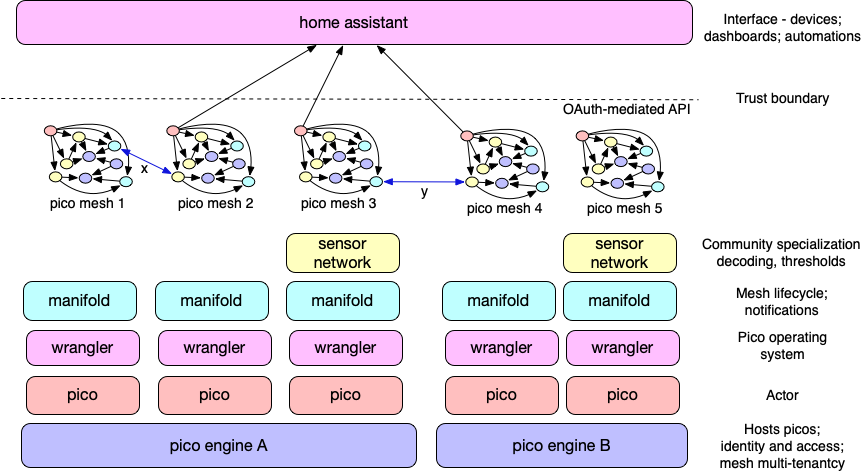
The figure above puts the whole thing in one place and labels what each layer does:
Pico engine—hosts the picos and supplies, among other things, identity: passkeys for the owner and OAuth for outside software. One engine can run several independent meshes at once, as shown in the figure.
Pico—the actor. Each pico is an independent, addressable entity with its own state, its own rules, and its own channels, and it interacts with other picos only by exchanging events. Everything above this layer in the diagram is running on picos.
Wrangler—the pico operating system. It gives each pico its channels, children, and subscriptions, and it is the machinery every higher layer calls to create picos and wire them together.
Manifold—the framework layer, responsible for mesh lifecycle and notifications. It controls a mesh comprising a root pico, a Manifold pico that creates and tracks things and communities, all the things and communities, and tag and skills registries. It fans alerts out to various channels. Everything above delegates that work to Manifold rather than building it again.
Sensor network—a domain layer that specializes the generic platform. It treats communities as sensor groups and things as LoRaWAN devices, decodes their payloads, and raises threshold alerts back through Manifold’s notifications.
Home Assistant—the interface, where a person actually sees and drives everything: devices, dashboards, and automations. The Manifold hub integration authenticates over OAuth and renders things and communities as Home Assistant devices, and a companion integration adds sensor entities for the domain layer beneath it.
The figure shows a classic delegation stack: each layer leans on the one beneath it and adds capabilities the layer below does not have. The one thing the figure hints at but does not yet deliver is the pair of light links between meshes, marked x and y. Those cross-mesh relationships are waiting on the pico-to-pico identity layer that is still ahead, which I will cover in its own post. That aside, this is the whole environment in a single picture.