Summary: Eve Maler argues that identity's apparent diseconomies of scale are really about gnarliness, not size. That gnarliness has a shape I drew for chapter 19 of my forthcoming book: the gap between a growing decision surface and the infrastructure meant to govern it. That gap is authorization pressure, and it explains why identity gets harder even when a team does everything right.

Eve Maler recently unpacked a statistic that is easy to misread. In her post she reports on an IANS Research finding that identity and access management was the only security category with negative economies of scale; IAM takes 8% of the security budget at organizations under $400M in revenue but 14% at organizations over $10B. The obvious reading is that identity gets more expensive, per dollar, the bigger you get. Eve’s better reading is that “gnarliness,” her word for the tangle that makes identity hard, is multi-factorial, and that company size is a poor proxy for it.
She lists the real drivers: how many jurisdictions you operate in, how large your partner ecosystem is, how many apps you are wiring to an identity provider, how loosely coupled your lines of business are, and whether anyone owns identity strategically. What predicts gnarliness, she argues, is not any single factor but the unique combination your organization lives with. Reading her post, I recognized a shape I had drawn for chapter 19 of my forthcoming book, Authorization in Action. I give the tangle she describes has a name and a diagram.
Gnarliness Has a Shape
In the book, I distinguish two things that grow at different rates as a system expands. The first is the decision surface: the total set of situations in which access has to be evaluated. The second is the decision infrastructure: the shared policy, consistent enforcement, contextual signals, governance, and delegation models that let those decisions be made well. The surface expands with more actors, more actions, more contexts, more delegation, and more automation. The infrastructure only expands when someone deliberately builds it.
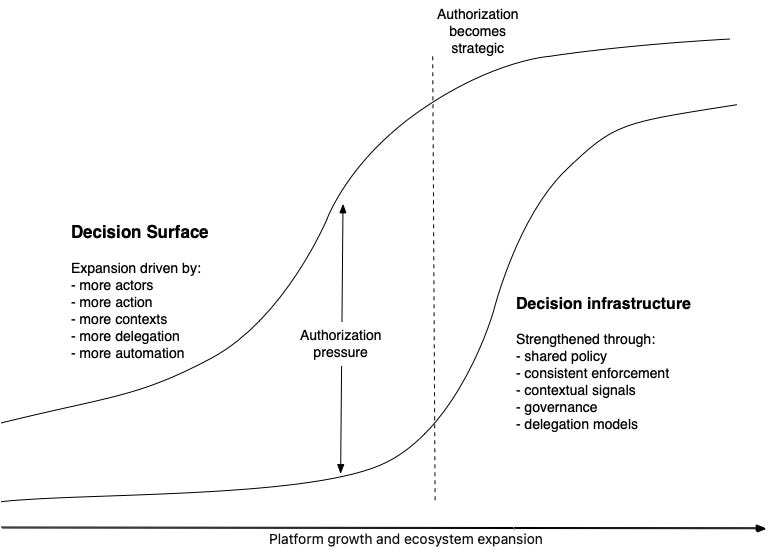
The gap between the decision surface and the decision infrastructure is authorization pressure.
When the surface outruns the infrastructure, the gap between them shows up as authorization pressure: the growing difficulty of making decisions consistently, explaining why they came out the way they did, and keeping control as the system scales. Pressure is not a failure of effort; ACME, the company I follow through the book, was improving access control the whole time. Pressure is what you feel when access decisions are being made everywhere and governed nowhere. Eve’s drivers of gnarliness map almost one to one onto the things that expand the decision surface; more jurisdictions maps to more context, a bigger partner ecosystem is more delegation, and more apps across more brands is more actors taking more actions.
Why Size Was Never the Predictor
Once you see identity’s difficulty as pressure rather than size, Eve’s objection to size as a predictor is easy to explain. Revenue and headcount tell you almost nothing about the decision surface. A small, acquisitive fintech operating in a dozen regulatory regimes, wiring together the identity systems of the companies it just bought, can carry far more surface than a giant consumer brand running one simple app for five hundred million users. The first organization is under enormous authorization pressure; the second is barely under any. Size isn’t what matters in either case.
That is also why IAM shows up as the category with negative economies of scale while other security categories get cheaper per dollar. The IANS number is not measuring the cost of being big. It is measuring the pressure that accumulates when the decision surface expands faster than the infrastructure meant to govern it, and large organizations have simply had more time and more room to let that gap grow. In other words, the diseconomies of scale are a symptom of authorization pressure, and the pressure itself is what you get when the decision infrastructure falls behind the decision surface. The underlying cause is an infrastructure that never grew to match the surface, not size.
Relieving the Pressure
You cannot relieve the pressure by shrinking the decision surface, because the business is the thing expanding it. Every new partner, every new market, every agent you deploy is simply the company doing what it exists to do. The only durable move is to strengthen the infrastructure so decisions stay consistent, explainable, and bounded even as the surface grows. That means externalizing policy out of application code, evaluating decisions at runtime against relationships and attributes and context, governing the signals those decisions depend on, and making delegation explicit rather than implicit.
This is where Eve’s diagnosis and mine reinforce each other most usefully. She notes that the organizations doing well with identity treat it strategically, often under someone she calls an Identity Product Owner, and that unified identity has started pushing downmarket wherever identity turns out to be a revenue multiplier rather than a cost. In the language of my book, those organizations have built decision infrastructure ahead of their decision surface, so the pressure never gets too high. Identity stops being the category that gets gnarlier with size and becomes a capability that lets a company expand the surface on purpose. A gap closed early is the difference between complexity that compounds and complexity you can manage.
The Surface Won’t Stop Expanding
Here’s the bad news: the decision surface is about to grow faster than it ever has. More interactions are crossing organizational boundaries; more actions are taken by services and agents instead of people; more decisions depend on real-time context that no static role can capture. I have argued in my series on agentic AI and authorization that agents expand the surface precisely because they act over time, under changing conditions, and often on someone else’s behalf. The pressure Eve measured in enterprise IAM budgets is the same pressure that will decide whether agentic systems are governable at all.
That is the human stake underneath the budget line. Authorization is how we govern the ways authority gets exercised, by our people, by our partners, and increasingly by the software acting for them. When the pressure is high, people confront a digital world of inconsistent permissions and unexplainable denials, a world where no one can say why the door opened or stayed shut. When the infrastructure keeps pace, authority is legible and bounded, and people can act with confidence inside clear limits. Eve is right: gnarliness is multi-factorial and size is the wrong thing to measure. What we should measure instead is the pressure between the decisions we now have to make and the infrastructure we have built to make them well. That pressure is something we can manage.
Photo Credits: Under Pressure from ChatGPT (public domain) and Decision Surface and Decision Infrastructure, from Chapter 19 of Authorization in Action (Manning)